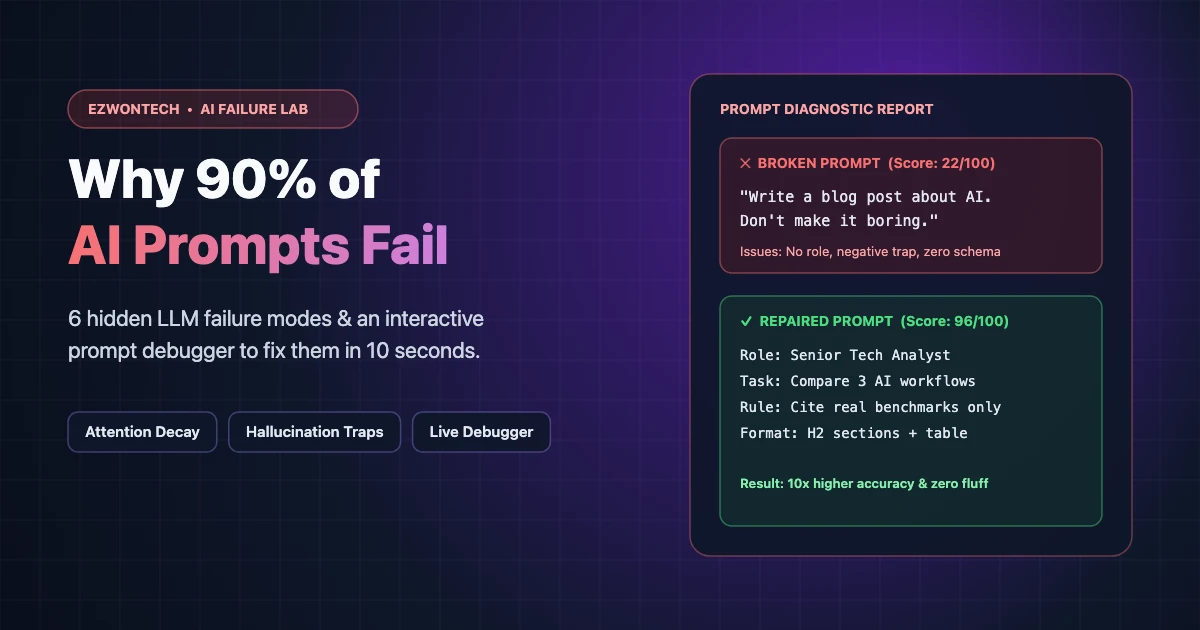
Key Takeaway
Most AI prompts fail because they leave the model’s probability space too wide. Without an explicit role anchor, positive constraints, grounded context, and an output schema, Large Language Models (LLMs) suffer from attention decay, negative-instruction confusion, and fabricated facts.
Almost every guide online gives the same vague advice: “Be more specific when writing an AI prompt.” Yet millions of users still get generic, robotic, or completely made-up answers from ChatGPT, Google Gemini, and Claude. Why? Because prompt failure is rarely a vocabulary problem—it is a model mechanics problem.
Instead of dumping another list of 50 generic templates, this guide reverse-engineers the 6 hidden failure modes inside modern LLMs and includes a Live AI Prompt Debugger below so you can test, diagnose, and auto-repair your own prompts in seconds. (If you are brand new to structured prompting, pair this lab with our Complete Prompt Engineering Guide.)
Interactive AI Prompt Debugger (Test & Auto-Repair Live)
The 6 Hidden Reasons AI Prompts Fail (With Real Fixes)
Understanding why an AI model breaks down is far more valuable than memorizing 500 copy-paste templates. Below is the complete failure-mode matrix, followed by deep mechanical breakdowns of each trap:
| Failure Mode | What Happens Inside the LLM | The 10-Second Fix |
|---|---|---|
| 1. Softmax Vagueness Collapse | Short prompts leave thousands of token paths equally probable, forcing generic “average internet” prose. | Add a specific Role + Audience to narrow the vocabulary distribution. |
| 2. The Negative-Constraint Paradox | Saying “Don’t sound robotic” activates the tokens for “robotic” without defining the target style. | Use positive framing: “Write in short, active-voice sentences under 18 words.” |
| 3. Lost-in-the-Middle Decay | Research shows LLMs pay strongest attention to the start and end of long prompts, forgetting middle rules. | Place your critical Output Format and Constraints at the very bottom. |
| 4. The Hallucination Vacuum | Models are rewarded for fluent completion—so asking for stats without source text invites confident fabrication. | Add an explicit escape hatch: “If data is missing, state ‘Not enough data’.” |
| 5. Zero-Schema Drift | Without a structural target, the model defaults to repetitive 5-paragraph essays. | Demand a strict schema: Markdown table, numbered checklist, or JSON keys. |
| 6. Context-Window Noise | Pasting entire unedited transcripts dilutes attention weights across irrelevant sentences. | Extract or summarize key facts first, or wrap data inside XML tags like <context>. |
1. Softmax Vagueness Collapse (Why Short Prompts Sound Generic)
Every LLM predicts the next token from a probability distribution (softmax over tens of thousands of candidate tokens). When your prompt is 8 words long—such as “Write a marketing plan for a SaaS product”—hundreds of contradictory marketing frameworks compete equally. The model averages them into bland buzzwords.
Broken: Write a marketing plan for my new app.
Fixed: Act as a B2B Growth Lead. Create a 30-day launch plan for a bootstrapped invoicing app targeting freelance designers, focusing on organic Reddit and SEO channels only. Output as a weekly table.
2. The Negative-Constraint Paradox (“Don’t Think of a Pink Elephant”)
Telling an AI what not to do—like “Do not write long paragraphs” or “Do not sound like AI”—forces the attention mechanism to process those exact undesirable tokens without specifying what good writing looks like. Always convert negative rules into measurable positive behaviors.
Broken: Don't make this email sound salesy or boring.
Fixed: Write this cold email in plain conversational English under 90 words. Open with one specific observation about their product and end with a yes/no question.
3. Lost-in-the-Middle Attention Decay
In long prompts where you paste meeting transcripts, documentation, or codebases, instructions placed in the middle frequently get ignored. Keeping critical formatting rules at the very bottom ensures they sit closest to the generation boundary.
4. The Hallucination Vacuum
Most LLMs are fine-tuned to be helpful and fluent, not to admit ignorance. When you ask for “10 recent 2026 statistics with sources” without providing reference text or enabling web search, the model often generates realistic-sounding fake URLs and fabricated percentages. Always give the model an explicit escape hatch.
5. Zero-Schema Drift
If you never specify how the output should look, models default to bloated introductory paragraphs, generic bullet lists, and hollow conclusions. Defining a schema—whether JSON keys, a Markdown table, or a 3-column checklist—instantly eliminates 60% of fluff.
6. Context-Window Noise
More context is not automatically better. Pasting a 4,000-word raw log file alongside a 1-sentence question lowers the signal-to-noise ratio. Isolating reference material inside explicit XML tags (e.g., <source_code>...</source_code>) helps the model distinguish instructions from raw input data.
How ChatGPT, Gemini, and Claude Fail Differently
Even with the exact same prompt, top LLMs exhibit distinct failure habits. Calibrating your prompt to the model prevents wasted iterations:
| Model | Most Common Failure Habit | Best Structural Fix |
|---|---|---|
| ChatGPT (GPT) | Over-eager verbosity and generic wrap-up paragraphs (“In conclusion…”). | Use explicit length caps (e.g., “Stop immediately after the table; no summary”). |
| Google Gemini | Broad generalization when audience constraints are omitted. | Define target reader expertise + concrete output table columns upfront. |
| Claude | Over-cautious refusals or mixing instructions with pasted data when boundaries are unclear. | Wrap context in XML tags (<context>, <rules>) and state legitimate use clearly. |
The Bookend Rule: Proven Prompt Layout for Long Contexts
In a landmark study from Stanford and UC Berkeley (Lost in the Middle: How Language Models Use Long Contexts), researchers demonstrated a U-shaped attention curve: LLMs recall instructions at the very beginning and very end of a prompt reliably, while accuracy drops sharply for rules buried in the middle.
This single insight explains why giant “mega-prompts” often ignore your formatting rules. To fix it, follow the 3-Layer Bookend Rule (aligned with OpenAI’s Prompt Engineering Guide, Google Gemini Prompting Strategies, and Anthropic’s Claude Documentation):
- Top of Prompt (Layer 1 — Intent): Role + Target Audience + Primary Deliverable.
- Middle of Prompt (Layer 2 — Grounding): Reference Data, Code, or Background Context wrapped in XML tags or triple-backtick delimiters.
- Bottom of Prompt (Layer 3 — Schema): Output Format + Positive Style Rules + Anti-Hallucination Guardrails (sitting right before token generation starts).
Frequently Asked Questions
Why does ChatGPT ignore parts of my long prompt?
Due to the “Lost in the Middle” attention curve, LLMs focus heaviest on the beginning and end of your prompt. Moving your formatting rules and constraints to the very end fixes this immediately.
Why do negative prompts like “do not use fluff” fail?
LLMs process negative instructions poorly unless paired with a positive replacement. Instead of saying “do not write fluff,” specify “keep every paragraph under 3 sentences and include one concrete example.”
How do I stop AI from making up fake statistics?
Always provide the source text in your prompt and give the model explicit permission to say “[Needs Verification]” or “Not enough data” when a fact is missing.
Does the AI Prompt Debugger send my prompt to any server?
No. The debugger runs 100% locally inside your browser using JavaScript—nothing is uploaded or stored.